
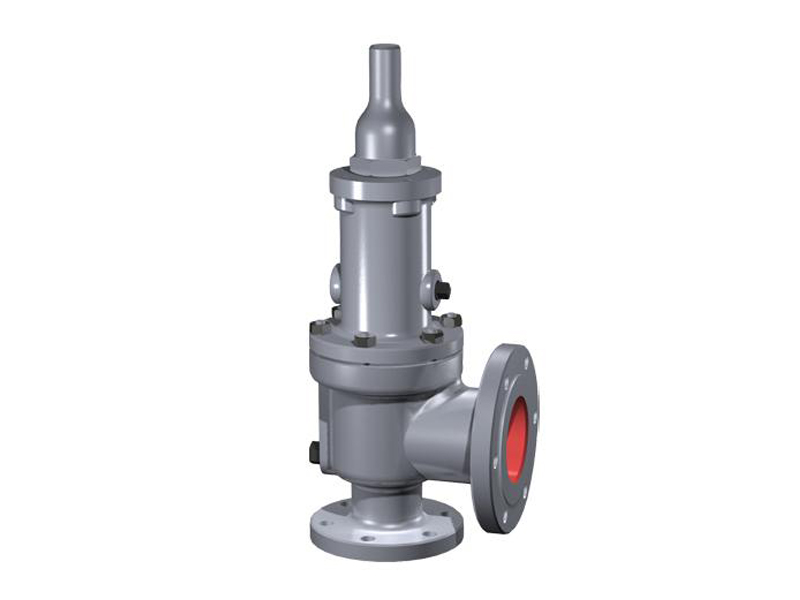
A safety valve protects pressure vessels, boilers and piping systems by releasing fluid when the pressure exceeds a safe limit. With an adjustable set pressure, it allows fluids to pass through the installation safely and prevents damage before it occurs. Luna Flow Control supplies safety valves from DN 15 to DN 200 and PN 16 to PN 40 / Class 150 to 300, for temperatures from -200 °C to +550 °C, in ductile iron, steel, stainless steel and bronze.
What Is a Safety Valve?
A safety valve reduces pressure by discharging fluid in a controlled manner when the pressure in the pipeline exceeds a certain value. It is used to keep the installation from being affected by overpressure and to ensure the safe passage of the fluid. Safety valves are used across industry, and in daily life they are most commonly found in combi boilers, where they protect the entire heating system from damage caused by high water pressure.
Working Principle
A safety valve works on the balance between the spring force and the fluid pressure. When the system pressure rises and overcomes the spring force, the valve begins to open and discharge fluid. It remains open until the pressure returns towards the set value; when the pressure drops to the closing pressure, the disc closes and reseats. The maximum permissible system pressure should be defined as the set pressure during installation.
How Is the Set Pressure Determined?
To determine the correct set pressure in bar, the characteristics of the system must be well understood: which fluid is used, which components are sensitive to high pressure and what operating pressure the installation needs. Once these factors have been evaluated, the set pressure can be defined and adjusted on the valve.
Types of Safety Valves
- Flanged safety valves – for any pressurised installation; they detect sudden pressure rises and discharge the fluid rapidly.
- Stainless steel safety valves – corrosion-resistant, for tanks, boilers, closed-circuit heating, solar energy systems and chemical service.
- Gas safety valves – open automatically when gas pressure exceeds the limit; widely used on pressure tanks and steam boilers.
- Water heater safety valves – discharge water to prevent overpressure in water heaters, heating boilers and tanks.
- Spring-loaded safety valves – the adjustable spring allows the opening pressure to be set, which is why they are also called adjustable safety valves.
- Steam safety valves – release steam when pressure rises in steam tanks and systems; large systems may require more than one valve.
- Spring-return safety valves – move the system to a safe open or closed position in critical situations, for example in food and chemical plants.
- High-pressure safety valves – for boilers, tanks, hot water systems and thermal plants operating at high pressure.
| Version | Pressure rating | Size range |
|---|---|---|
| Full-lift safety valves | PN 16 – 40 / Class 150 – 300 | DN 15 – 200 / 1″ – 8″ |
| Bronze safety valves | PN 16 – 40 / Class 150 – 300 | DN 15 – 200 / 1″ – 8″ |
Application Areas
- Water heaters and hot water systems
- Central heating and boiler systems
- Plumbing installations
- Solar energy systems
- Pressure tanks and steam boilers
- Industrial process lines
Maintenance Tips
Check safety valves at regular intervals to confirm that they open at the set pressure and reseat tightly. Make sure the discharge outlet is unobstructed, and never adjust the set pressure above the maximum allowable pressure of the protected equipment.


