
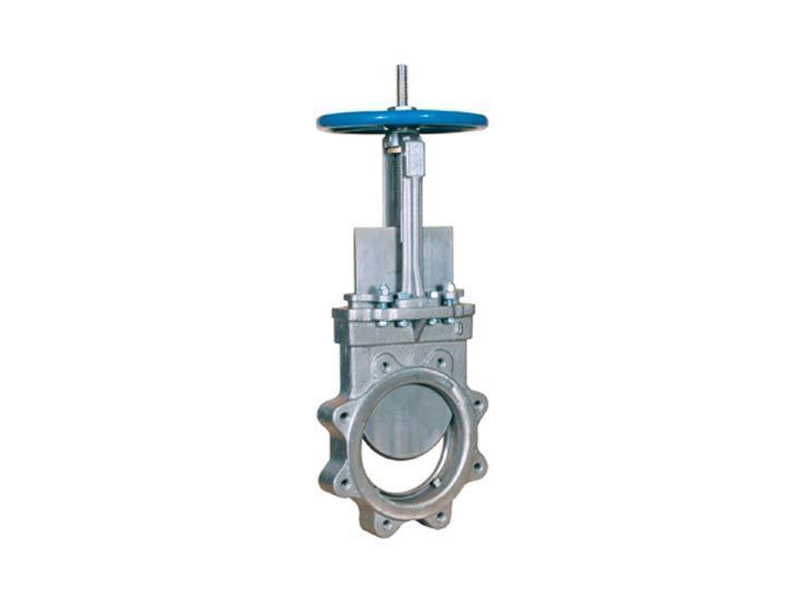
A knife gate valve is one of the most reliable valve types for lines carrying media with a high solids content. Its distinctive knife-edged gate allows it to handle fluids that would clog or damage other valves. Luna Flow Control supplies knife gate valves in a wide range of nominal diameters and pressure ratings to suit many pipeline designs.
What Is a Knife Gate Valve?
A knife gate valve opens and closes the flow passage in installations with a high density of solid particles. It takes its name from the blade-shaped gate, which moves perpendicular to the flow and engages with the valve body to stop the medium. In addition to solids-laden fluids, knife gate valves are used for corrosive media; because the gate is not affected by abrasive particles, the valve maintains full sealing.
Working Principle
The knife-edged gate sits on gaskets perpendicular to the flow. When the handwheel is turned, the blade moves down and closes the passage, and the gaskets create a complete seal. Turning the handwheel in the opposite direction lifts the gate and reopens the line. Any solid material in the path of the gate is cut by the blade, so the valve closes without clogging. Knife gate valves are designed to be fully open or fully closed and are not intended for flow regulation.
Types of Knife Gate Valves
- Stainless steel knife gate valves – long service life, full sealing and very low pressure loss when fully open.
- Pneumatic knife gate valves – compact and easy to install, especially suited to fibrous media.
- Piston knife gate valves – mainly used in wastewater lines; available with one-piece or two-piece bodies, bidirectional and installable in any orientation.
- Electric actuated knife gate valves – automatic opening and closing where manual operation is difficult.
- Lug type knife gate valves – ideal for fibrous media in unidirectional flow; the blade cuts fibres and prevents clogging.
- Wafer type knife gate valves – compact design with high performance in fluids with a high solids content.
Key Features
- Suitable for wafer, lug and double-flange installation
- Resistant to corrosion and wear from abrasive particles
- Gate moves perpendicular to the flow and cuts fibrous material
- Gearbox, electric, pneumatic and hydraulic actuators can be fitted
- Full sealing with low maintenance requirements
Application Areas
Knife gate valves were originally developed for the paper industry and are now used for oil, slurry, grease, pulp and wastewater in many sectors, including:
- Wastewater treatment plants
- Pulp and paper industry
- Food and beverage industry
- Power plants, cement plants and chemical plants
- Plants handling heavy and light oils
- Plants handling sludge or slurry, mining and bulk handling
- Hot and cold water lines
Size Ranges
| Version | Pressure rating | Size range |
|---|---|---|
| Wafer, unidirectional standard | PN 10 – 16 / Class 150 | DN 50 – 2000 |
| Bidirectional (standard and custom) | PN 10 – 16 / Class 150 | DN 50 – 2000 |
| Mining and silo applications | PN 10 – 16 / Class 150 | DN 50 – 2000 |
| Double-slide, pneumatic actuated | PN 10 – 16 / Class 150 | DN 200 – 2000 |
| High pressure | PN 10 – 100 | DN 80 – 2000 |
| Bidirectional high pressure | PN 40 – 100 | DN 80 – 2000 |
Selection Tips
Valve dimensions are among the most important factors to check before purchase: a valve that does not match the line will not operate correctly. Confirm the nominal diameter (DN) and nominal pressure (PN), then select the body, gate and seal materials according to the abrasiveness, corrosiveness and temperature of the medium.


